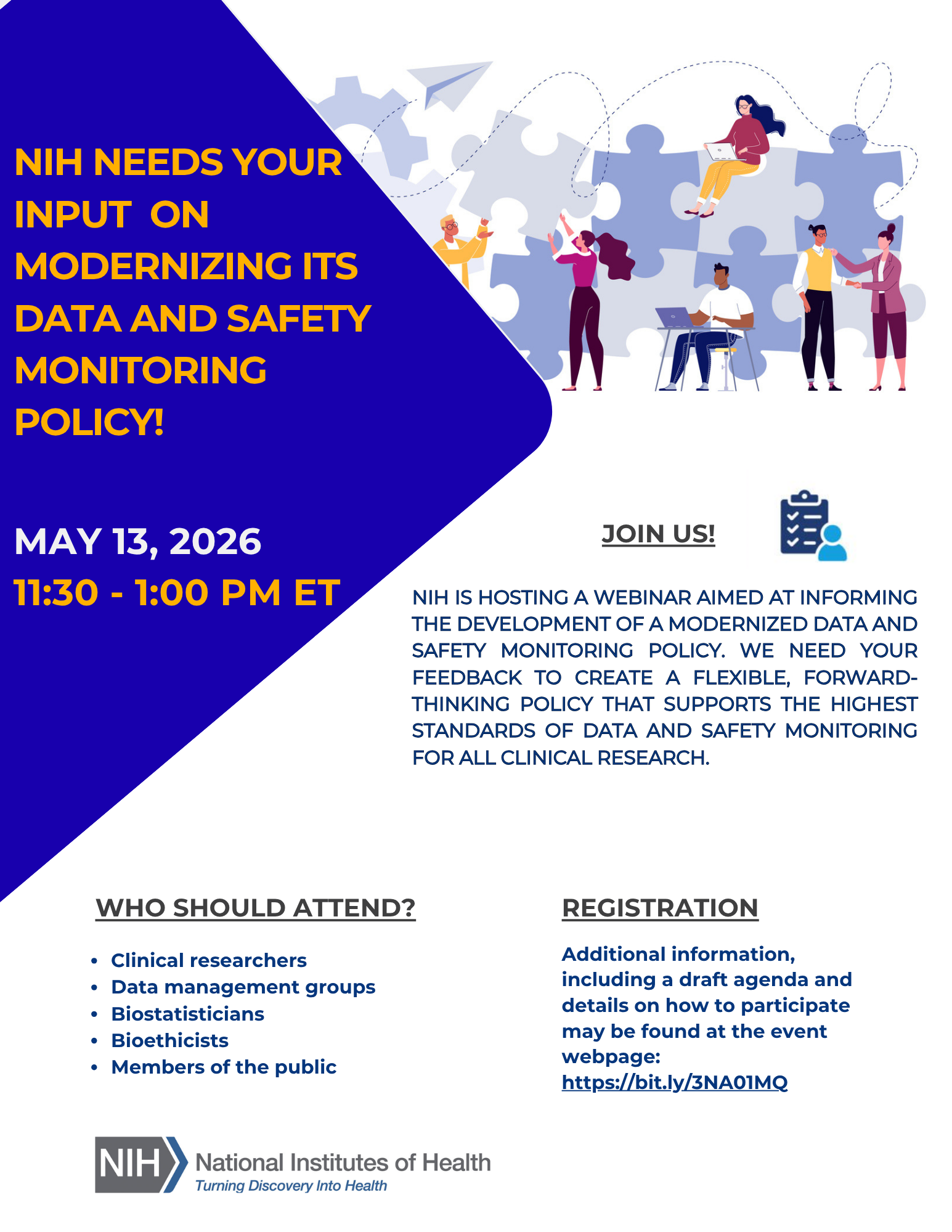
To enhance efficiency and rigor, NIH intends to modernize the approach to data and safety monitoring and is committed to engaging the public in development of an updated policy. Since the 1998 NIH Data and Safety Monitoring Policy was published, study designs and monitoring practices have evolved, creating the need for more efficient and flexible practices to monitor data for all clinical research. NIH plans to modernize the Data and Safety Monitoring Policy starting with gathering input from the public, experts in the field, and the research community.
All types of clinical research studies can – and should – have a plan for monitoring data and safety. These studies include a broad range of clinical research studies, such as observational studies, behavioral and social science research, implementation science, and clinical trials of drugs and devices.
Data and safety monitoring plans identify the approach and procedures for monitoring the quality and scientific reliability of the data, and the safety of participants.
Plans include procedures for evaluating and reporting on the data and safety of the study.
Plans identify the appropriate level of monitoring for the study and describe how that monitoring will be conducted.
Monitoring can range from the principal investigator only to including an independent monitor(s) or committee, like a Data and Safety Monitoring Board (DSMB).
NIH welcomes any comments on modernizing the Data and Safety Monitoring (DSM) Policy. We accept any comments, but we are specifically interested in hearing individual opinions on the following topics:
Study characteristics that should be considered when evaluating what an appropriate monitoring approach, plan, or level of monitoring is for the study. For example, this could include the study design, types of outcomes, data privacy and security, US or global regulatory structure, number of sites, and quantity and types of data.
Key components of an effective data and safety monitoring plan; considering data, safety, scientific integrity, protocol adherence, and study continuation.
Types of research that should be covered under the modernized DSM policy. Key categories are 1) all clinical research (including clinical trials and non-clinical trials) and 2) all research involving humans, including identifiable private information or specimens (i.e., secondary research involving de-identified private information or biospecimens).
Guidance, templates, or educational material that would help the research community 1) understand data and safety monitoring principles, 2) develop effective data and safety monitoring approaches and plans, and 3) implement data and safety monitoring rigorously and to the highest ethical standards.
Registration
The webinar is open to the public and there is no cost to attend. Registration is required using the form below.
NIH is undertaking a comprehensive policy development process that will require researchers and institutions to responsibly share summary level study results to research participants in plain language for all NIH-supported clinical research. This webinar, co-hosted by the Multi-Regional Clinical Trial Center of Brigham and Women’s Hospital and Harvard, is an opportunity for stakeholders to provide feedback to inform the development of that policy.
NIH encourages any interested individual to sign up to provide oral comments during the listening session. All comments offered at the listening session are welcome and will be considered. Feedback on the following topics is particularly encouraged.
What to include in summary level study results shared with participants. Specifically:
Elements and information that should be expected to be included in summary level study results shared with participants
Situations when not sharing summary level study results with participants may be justifiable
Strategies for generating plain language summaries, including the use of AI tools
How to share summary level study results with participants. Specifically:
Best practices for participant engagement to ensure that results are returned in meaningful ways and participants know what to expect
Acceptable and preferred methods for sharing and receiving summary level results
Potential costs related to generating and sharing summary level results
Additional considerations related to ensuring results are returned responsibly
When to share summary level study results with participants. Specifically:
Timing of sharing summary level study results (during or after the study)
Registration
The webinar is open to the public and there is no cost to attend. Registration is required using the form below.
NIH, with the University of California Biological Safety Officer’s Working Group, BioNet, and the Arizona Biosafety Alliance will be hosting the sixth in a series of public listening sessions to obtain stakeholder feedback on NIH’s effort to modernize and strengthen biosafety oversight.
Priority for providing oral comments at this meeting will be given to stakeholders located in: California, Arizona, Nevada, Oregon, Washington, Alaska, and Hawaii.
NIH and its partners encourage any interested individual to sign up to provide oral comments during the listening session. All comments offered at the listening session are welcome and will be considered, including topics covered at previous sessions. Feedback on the following topics is particularly encouraged.
Opportunities to improve IBC functions and advance transparency
Roles and responsibilities of institutions, IBCs, investigators, and NIH to strengthen compliance and transparency
Ways to strengthen coordination between IBCs and other institutional review bodies (e.g., Institutional Animal Care and Use Committees)
Infrastructure and communication
Liaison members between committees
Options for review and approval of lowering requests
Requests to lower containment for research involving RG3 or RG4 agents or conducted at BL3 or BL4
NIH review and approval of all requests
NIH review and approval of initial request, then eligible for IBCs to approve subsequent requests after risk assessment of specific experiments
NIH and its partners encourage any interested individual to sign up to provide oral comments during the listening session. All comments offered at the listening session are welcome and will be considered, including topics covered at previous sessions. Feedback on the following topics is particularly encouraged.
The utility of agent risk groups (RGs) as a starting point in determining appropriate containment for specific experiments
Opportunities to improve IBC functions and advance transparency
Committee activities: Options for expedited reviews (e.g., chair/less than full committee, BSO) including situations or types of research, if any, where expedited reviews would be appropriate
Roles and responsibilities of institutions, IBCs, investigators, and NIH to strengthen compliance and transparency
Requirements for membership (e.g., flexibility in required expertise, local members)
Requirements for improved public access to meetings and minutes
Requirements for reporting of incidents or violations to NIH (and the threshold for incident reporting)
Ways to strengthen coordination between IBCs and other institutional review bodies (e.g., Institutional Animal Care and Use Committees)