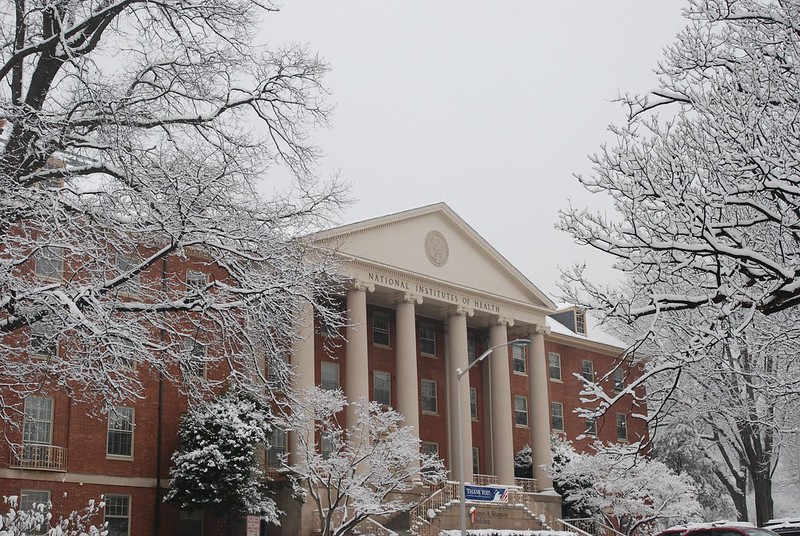
What are your plans for the summer? What about spending the summer with NIH building your science policy skills? If this sounds interesting, the OSP Summer Internship Program might be right for you. This virtual internship program will take place over the course of 8-12 weeks beginning in late May/early June 2024. Applications must be received no later than February 12, 2024.
Questions may be sent to [email protected]. If you are not yet a subscriber to this listserv, please sign up here. You can follow us on Twitter @NIH_OSP as well as LinkedIn.
If I were to tell you that I have a very important similarity to people like Steven Spielberg, Oprah Winfrey, Tom Hanks, and Mindy Kaling, what would you say? Your first reaction might be, “Obviously, Lyric. We already know that you are all so wildly famous that you can’t go to the grocery store without a sharpie to sign autographs for your fans.” Unfortunately, I have not (yet) achieved that level of fame, wealth, or recognition. In actuality, the real connection I have to these celebrities is that we all started our careers off with an internship!
In the beginning of my career, I knew I loved science but had a sense that being at the bench wasn’t the path I wanted to pursue. As a scientist pursuing a Ph.D., this was a scary thought! What other careers were out there for people who wanted to advance science by identifying problems, generating evidence, and communicating findings outside of the lab? Fortunately, I had already discovered the value of a professional network, and mine turned me on to an internship with AAAS that allowed me to explore the policy world. I think it is fair to say that I never looked back after learning about how much I can contribute to furthering research through policy.
When I began my leadership role at OSP, one of my primary goals was to develop a world-class paidinternship program that could provide access for budding policy professionals to gain exposure to the exciting world of science policy. Last summer, we launched the first official OSP Summer Internship Program, and I think it was a phenomenal success. The applicant pool was fierce, and the interns selected gained valuable experience in how a government policy office operates: the good, the bad, and the ugly. Conversely, OSP also learned from our interns some valuable lessons from their perspectives and experiences, (at the end of this piece, please see some testimonials from our inaugural class of interns) and they substantially contributed to some of the major issues we were working on at the time.
With our first year under our belts, I am beaming with excitement to launch year two. We are now accepting applications for the 2024 Summer Internship Program! After looking at the 2023 Program, we made some enhancements that will make things even better. The biggest change is the 2024 Program will be open to undergraduates as well as students in a graduate or professional degree-seeking program. Another change we have made is the application process. OSP has developed an easy-to-use portal that allows applicants to easily determine eligibility and submit documentation and references.
I encourage anyone with an interest in a policy career to apply for the 2024 OSP Summer Internship Program. One day you could add your name to mine, Steven’s, Tom’s, and Oprah’s and Mindy’s as intern alums.
PS: Another benefit of an internship is that you get to call celebrities who also interned by their first names even if you have never meet them!
Straight From the Class of ‘23
Name: Nina D’Amiano, MPH (MD expected May 2024) Institution: Johns Hopkins University What would you say was your biggest takeaway from the OSP Internship Program? At OSP, I learned about the appropriations process and selection of policy priorities. My main project was to coordinate with various NIH ICOs to prepare the annual NIH Congressional Justification. I recognized the need for experts to participate in policy and the legislative processes and gained experience translating technical, scientific knowledge into language that is understandable and useful to decision makers and the public alike. I saw how research-derived scientific knowledge can be applied to real-world policies that directly impact Americans. I hope to pursue a career in medicine through which I can impact health outcomes through policy and advocacy.
Name: Abigail McElroy (PhD student in Neuroscience) Institution: Emory University What did you enjoy most during your time as an intern at OSP? I started this internship having a longstanding curiosity about science policy, but not really knowing anything about what it was or how it worked. I was excited to get to see what the field was like close-up and enjoyed getting to interface with people in the policy office and find out what they did. I especially liked reading the Request for Information responses and getting to be a part of how those public comments would be incorporated into the policies OSP were crafting.
Lyric Jorgenson, PhD
NIH Associate Director for Science Policy
About Lyric
NIH, through the Office of Science Policy, is announcing the availability of administrative supplements to support research on bioethical issues that either inform future policy directions or augment bioethics research capacity. For more information, including special areas of interest and application instructions, please visit https://grants.nih.gov/grants/guide/notice-files/NOT-OD-24-031.html. Applications will be accepted until 5:00pm (applicant local time) on April 1, 2024.
For more information on prior supplements, please see here.
Questions about specific Institute, Center, or Office research priorities should be directed to the contact listed in the notice.
When I think of December, my thoughts usually turn to the holiday season, time with friends and family, and the anticipation of one year ending and a new one about to begin (it also brings to mind cold weather and limited daylight but that is for another blog). When it comes to life at NIH though, December means the biannual meeting of the Advisory Committee to the NIH Director (ACD) and updating the public on some of the key activities the agency is spearheading in service to science and society.
For readers that are unfamiliar with the ACD, this committee provides expert advice on some of the most pressing issues facing the NIH and the research we conduct and fund. While all ACD meetings involve interesting presentations and thought-provoking questions, this one will be a very special one as it will be the first ACD meeting for Dr. Monica Bertagnolli in her capacity of NIH Director!
In addition to the excitement of having Dr. Bertagnolli at the meeting, I am very proud that the agenda is chockablock with issues in which OSP is either the lead for the agency or a substantial contributor. Everyday I see the brilliance of the OSP staff in dealing with extraordinarily complex issues. It is a gratifying to be able to stand up in front of one of NIH’s most expert committees and detail the fruits of that labor.
During the December 14-15 meeting of the ACD, I will be busy participating in three presentations. The first talk, on the afternoon of the 14th, will be a status update on the work of the Novel Alternative Methods (NAMs) Working Group (WG) that I will be presenting with my WG co-chair, Dr. Howard Chang. During this presentation, Dr. Chang and I will detail the WG’s recommendations on how NIH can best catalyze and develop NAMs and transform our understanding of human health in the process.
The second presentation will kick-off the morning session on the 15th. Dr. Garth Graham and I, as co-chairs of the HeLa Genome Data Access WG, will discuss the requests we have received for the full HeLa who genome sequence since the previous ACD meeting. Since 2023 marks the 10th anniversary of the NIH-Lacks Family Agreement, the bulk of the presentation will focus on how NIH can continue to promote this unique partnership.
The final presentation in my trifecta is near and dear not only my heart, but Dr. Bertagnolli’s as well. The talk will focus on how NIH is fostering engagement, transparency, and trust in clinical research. This is an exciting topic, and I will describe some of the steps we hope to take to more fully incorporate public voices in the design, planning, and dissemination of NIH-funded clinical research. I can’t lie, I am a little nervous that my voice might not make it through all these presentations! Nevertheless, I am willing to risk sounding like Kermit the frog for a few days so that I can help spread the word about the important work OSP and NIH are undertaking. I invite you to join me at the ACD meeting taking place on December 14-15. The full agenda and webcast information can be found at: https://acd.od.nih.gov/meetings.html
Lyric Jorgenson, PhD
NIH Associate Director for Science Policy
About Lyric