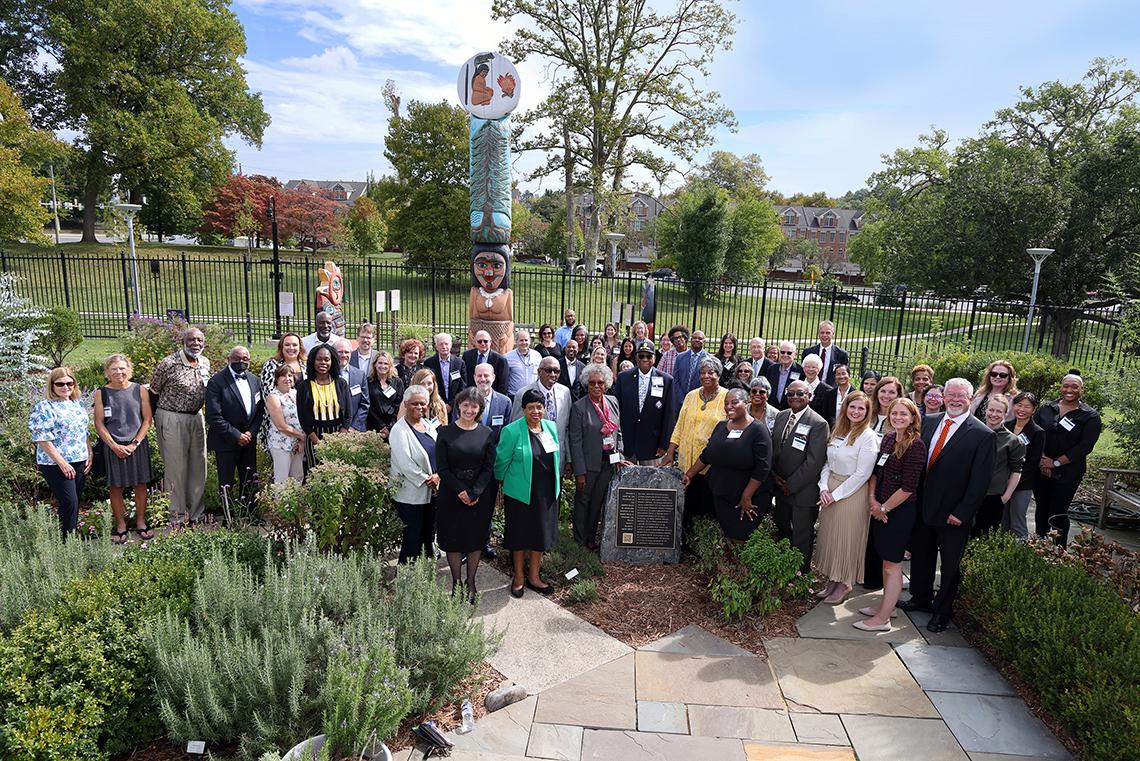
Event Honors NIH Partnership with Voices For Our Fathers Legacy Foundation

This is an excerpt from the October 11, 2024, issue of the NIH Record.  The article below was authored by Eric Bock and all photos were taken by Chia-Chi Charlie Change. The original article can be found at: https://nihrecord.nih.gov/2024/10/11/event-honors-nih-partnership-voices-our-fathers-legacy-foundation

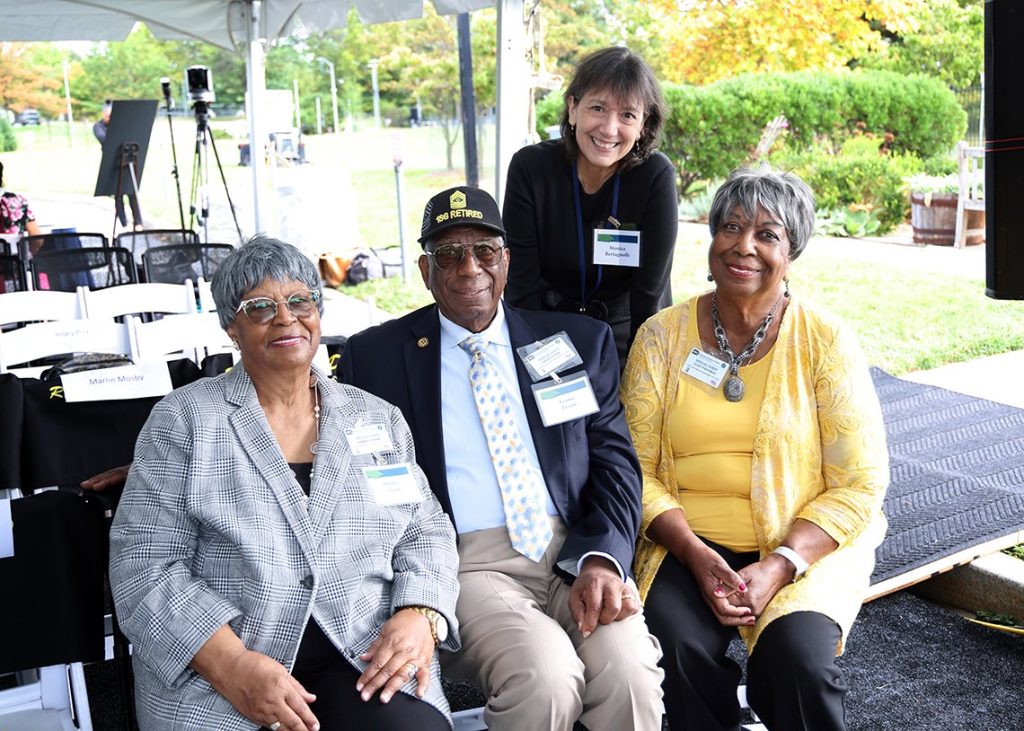
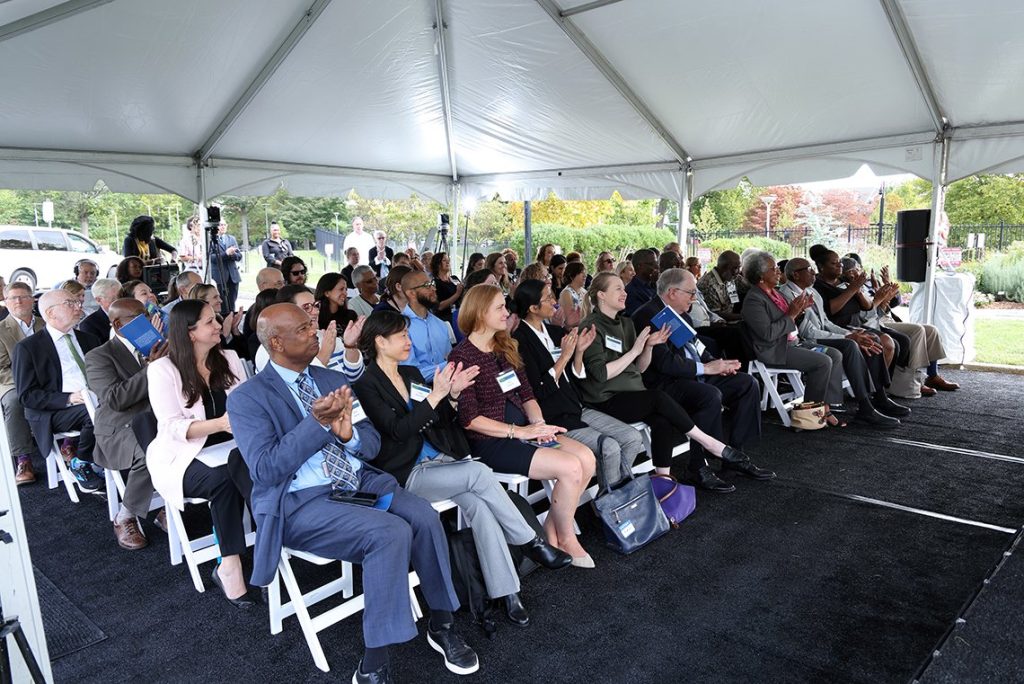
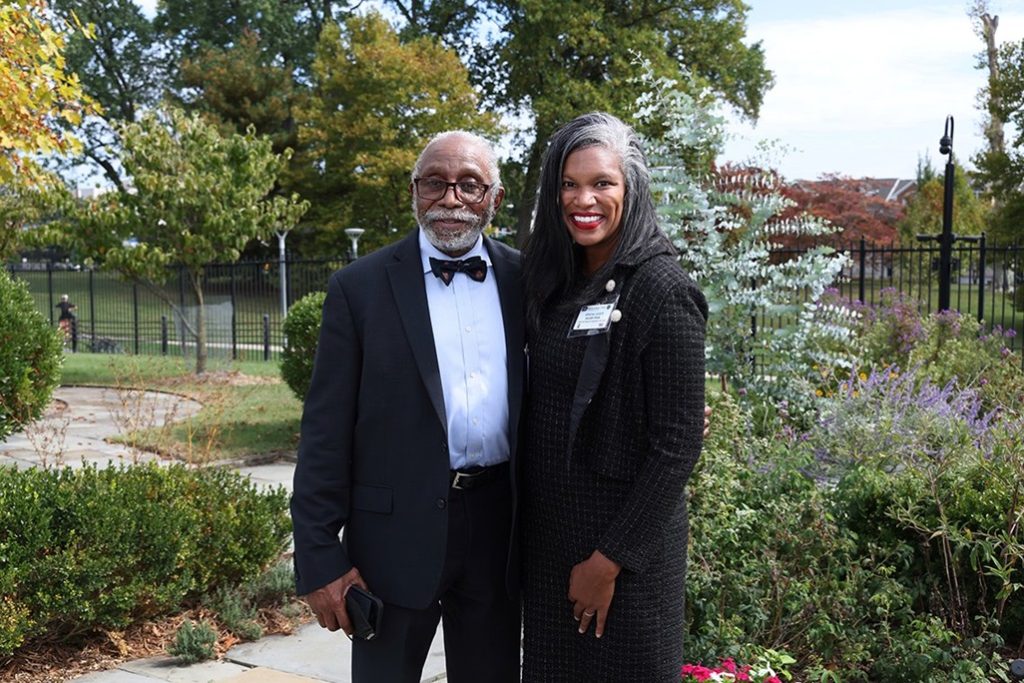
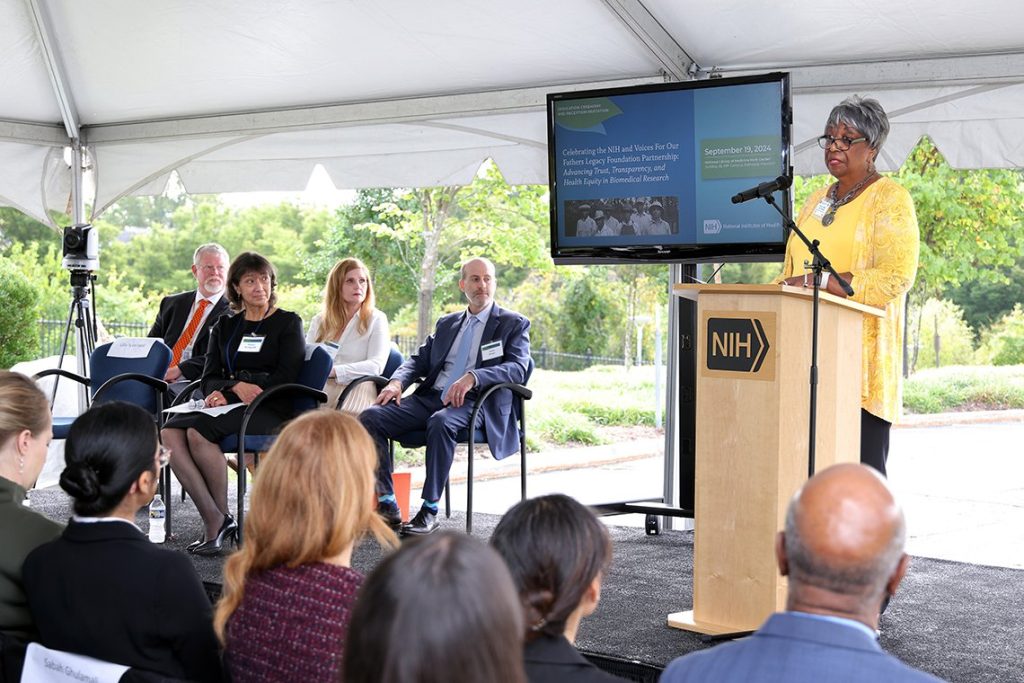
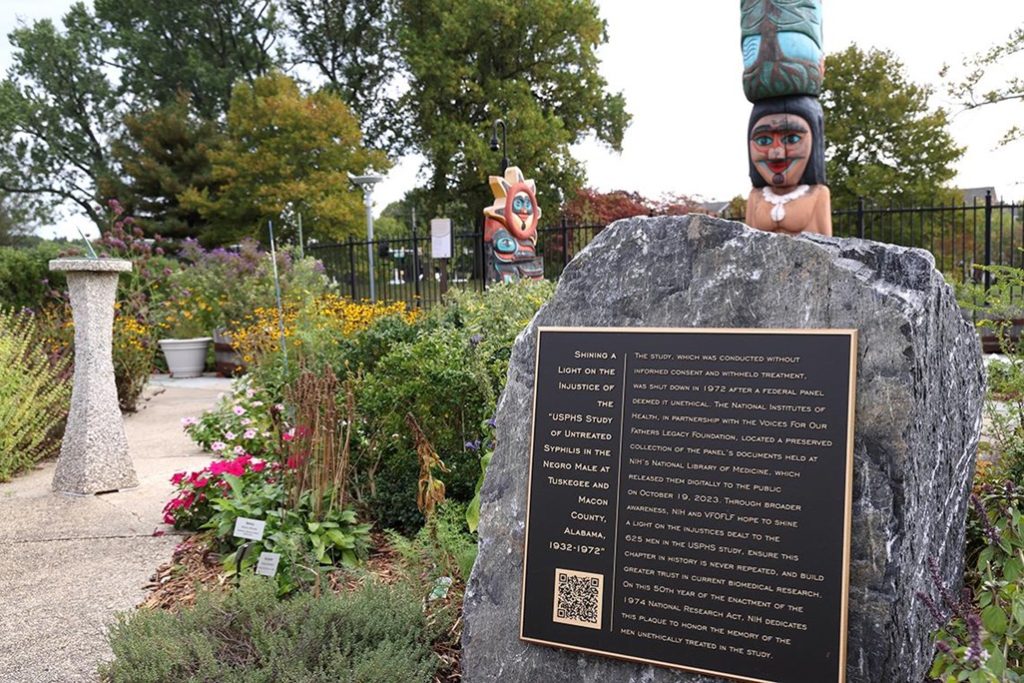
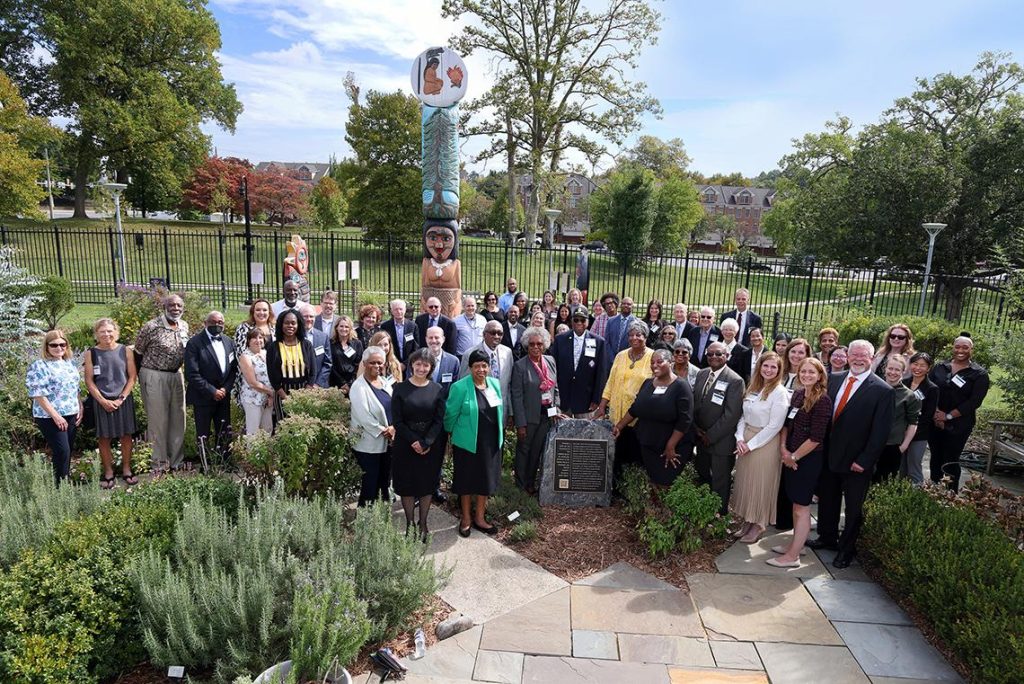
NIH recently debuted a plaque honoring the memory of the African American men unethically treated in the U.S. Public Health Service (USPHS) Untreated Syphilis Study and the 50th anniversary of the National Research Act at the National Library of Medicine (NLM) herb garden, across from Bldg. 38, on Sept. 19.

“This plaque shines a light on the injustices of the past, not letting us forget them so they are never repeated,” said NIH Director Dr. Monica Bertagnolli during the dedication ceremony. “NIH is committed to making biomedical research inclusive and accessible for everyone.”

In 1932, the study began in Alabama. Originally called the “United States Public Health Service Study of Untreated Syphilis in the Negro Male at Tuskegee and Macon County, Alabama,” the study enrolled 625 African American men. Researchers conducting the study did not obtain informed consent and did not offer treatment, even after it was widely available.

“Much is known about the inhumane, immoral, unethical treatment of these men,” said Lillie Tyson Head, founding president of the Voices For Our Fathers Legacy Foundation, a nonprofit formed by the descendants of the men who were treated unethically in the study. “But little is known about their humanity.”

As Tyson Head noted, most of the participants were poor sharecroppers who had little time or money for doctor visits. During the growing season, they spent their time working in vegetable gardens, tending to farm animals and preparing fields for corn, beans and cotton. They had few opportunities to learn to read and write.

These men were sons, husbands, fathers and brothers. “The most important things to them were caring and providing for their families,” she said.

The study ended in 1972, after a reporter exposed it and a federal committee, which met at NIH among other locations, recommended the study be shut down. After a public outcry, the National Research Act was signed into law, creating federal rules to protect human research participants. The law was a direct response to the men who were mistreated in the study.
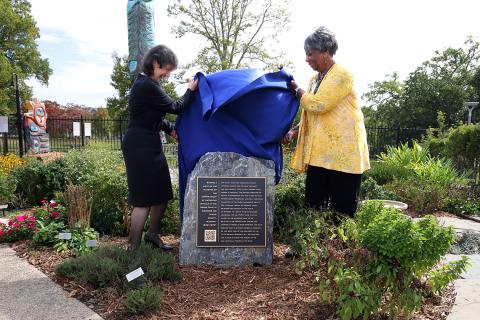
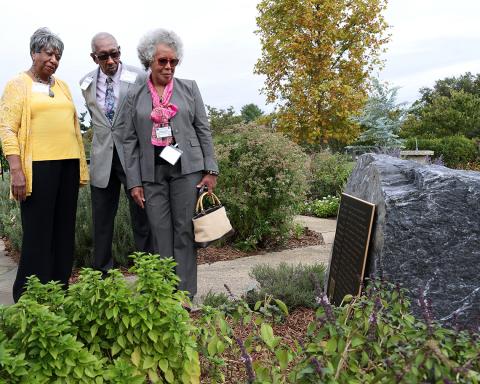
“We understand that history cannot be undone,” said Tyson Head. “We can construct bridges to trustworthiness and health care. By working together, we can make health equity a reality, dismantle racial and social injustices and advance biomedical research.”

Recently, the foundation met with NIH leadership to discuss how NIH could assist in uncovering the truths held within records that might be yet undiscovered, said Dr. Lyric Jorgenson, NIH’s associate director for science policy. NIH worked with the foundation to locate and preserve documents from the study.

“We are incredibly pleased that we could work with these leaders and help shed some additional light on this unjust effort so that we may never again repeat our past,” said Jorgenson.

Documents from the study are now publicly available on NLM’s website, said acting NLM Director Dr. Steven Sherry. Working closely with Fisk University, NLM digitized more than 3,000 records from the study. Examples of records include correspondence, meeting minutes, reports and scientific articles. Previously, these documents were only available in physical form.

“NLM’s stewardship of this collection supports our mission to enable biomedical research and support health care and public health through free online access to scholarly biomedical literature,” he said. “Our goal for this significant collection is to reach a broad audience and serve as a beacon of transparency with the biomedical and health care community.”
The National Research Act acknowledges the government’s past failures and commits health officials to a future where ethical principles are paramount to the conduct of research, said Department of Health and Human Services Assistant Secretary for Health ADM Rachel Levine in recorded remarks.

“The National Research Act is the U.S. government’s commitment to the American people that the pursuit of knowledge must not come at the cost of human dignity and human rights,” Levine concluded. She thanked everyone in attendance for partnering to ensure transparency and high ethical standards in research to create a healthier future for all who live in the U.S.

View the full collection of documents from the study at go.nih.gov/PCjiOXk.
Lyric Jorgenson, PhD
NIH Associate Director for Science Policy
About Lyric

(Coming Soon) Supervisory Health Science Policy Analyst (Assistant Director for Biosecurity)

The NIH Office of Science Policy seeks an innovative leader to serve as the Assistant Director for Biosecurity within its Division of Biosafety, Biosecurity, and Emerging Biotechnologies.  The ideal candidate will have extensive experience and knowledge regarding relevant scientific and policy issues such as those related to biosecurity, dual use research, preparedness, synthetic biology, and the bioeconomy.

The position is being advertised as a supervisory GS-14.  The application period will open on Thursday, October 17 and close on Monday October 21, 2024.

Current federal employees may apply at: https://www.usajobs.gov/job/812289700

Members of the public should apply at: https://www.usajobs.gov/job/812289500

For more information about the NIH Office of Science Policy, go to https://osp.od.nih.gov/

NIH Releases Final Scientific Integrity Policy 

Today, NIH is releasing the Final Scientific Integrity Policy of the National Institutes of Health. The final policy incorporates and is responsive to the principles and directives of the Presidential Memorandum on Restoring Trust in Government Through Scientific Integrity and Evidence-Based Policymaking, Protecting the Integrity of Government Science, and A Framework for Federal Scientific Integrity Policy and Practice

In developing this policy, NIH also considered all the comments received during the Draft Policy public comment period. The final policy articulates the procedures and processes in place at NIH that help maintain rigorous scientific integrity practices. Additionally, the final policy describes several new functions to further enhance scientific integrity at NIH and throughout the biomedical research enterprise.

The Policy will take effect on December 30, 2024. 

If you are not yet a subscriber to this listserv, please sign up here.   Also, you can follow us on X: @NIH_OSP

How I Spent My Summer Vacation

I SPENT SOME TIME GETTING IN TOUCH WITH MY CREATIVE SIDE

This summer started off great for OSP from a creative standpoint.  First, we developed a new informed consent language resource to help the research community responsibly communicate about digital health technologies. Our creative juices were still flowing throughout July when we launched a new PartnersinResearch site that also includes 14 NIH Institute, Center, and Office case studies (and counting!) that researchers, patients, patient advocates, and caregivers can use to strengthen their own patient engagement approaches. Barreling into August we launched a new page on the OSP website that revisits NIH’s policy framework as it relates to advancing artificial intelligence to help researchers think through the implications of the development and use of this technology.

I MET SOME REALLY AMAZING NEW PEOPLE!

Recently, NIH Principal Deputy Director, Dr. Larry Tabak, OER Deputy Director, Dr. Liza Bundesen, and I had the honor of hosting the heads of 15 German research universities as part of a delegation visit to the US. It was so great to be able to share the NIH story with our international partners, which included discussions about how NIH makes funding decisions. As an extra bonus, they took a tour of our one of kind, state of the art research hospital, the NIH Clinical Center.  We heard that nothing like NIH exists in Germany, so I think they left impressed! We all promised to K.I.T.

Entering into the second year of the OSP summer internship (recently expanded to undergraduates), OSP hosted three amazingly talented interns who accomplished some really impressive projects – stay tuned for their stories. Details on how to apply for next summer’s internship will be posted to the OSP website in January 2025.

Finally, I was energized to meet with the policy professionals of tomorrow when I joined the NIH Oxford–Cambridge Scholars Program Annual Colloquium. Here, I shared about how I got engaged in science policy and hopefully imparted some nuggets of wisdom for navigating the trajectory!

I TOOK SOME TIME TO SIT BACK AND REALLY LISTEN

The best way to solve a problem is to ask for help from many, many different people!  This summer OSP asked for a lot of help, which you may have seen through our numerous requests for information on policy issues related to promoting equity in access planningraising public voices in clinical research, and public access to NIH-supported research findings. We are always immensely grateful for time people take to provide thought-provoking feedback, which can ultimately be found on the public comment page of the OSP Website once we’ve sorted through it all!

This summer we also hosted two listening sessions on issues we are really passionate about. The first session focused on NIH levers to promote access to NIH discoveries.  The second session was co-hosted with our fantastic partners at CISCRP and our NExTRAC ENGAGE leaders, and focused on hearing from individuals their perspectives on engagement in clinical research.

I ROCKED OUT TO SOME SWEET MUSIC

While I am an active concert goer, I was particularly excited about being among the invited guests to see the unveiling of Dr. Francis Collins’ NIH Director portrait.  Of course, if Dr. Collins is in attendance, there is an excellent chance that Rosalind (his guitar) will also be in the house. As you can see, Dr. Collins serenaded the audience, which included his wife Diane, former Senator Roy Blunt, former NIH Director Dr. Elias Zerhouni, current NIH Director, Dr. Monica Bertagnolli, several of the NIH Institute Directors and many others whose lives were touched by this inspirational leader.

I TOOK TIME FOR A REAL VACATION!!

As you might be able to tell, it was a busy summer. So much happened over this summer that I feel like it just flew by.  Thankfully, I did get a little bit of time to take a vacation to see friends, family, and Babe, the blue ox at Paul Buyan land. I truly hope you were able to also take some time to enjoy the summer as well! 

With summer now in the rearview mirror, I am excited to see what the fall brings. If the past is any indication, the fall will be a busy time here at NIH.  Some things to look forward to as we enter the last few months of 2024 include the next iteration of NIH’s annual bioethics supplement, the finalization of the numerous policies discussed above, community conversations related to the ENGAGE initiative, the meeting of the Advisory Committee to the NIH Director in December and much more. Feel free to share your summer pics with us as well!

Lyric Jorgenson, PhD
NIH Associate Director for Science Policy
About Lyric